FRP Pultruded Grating
FRP pultruded grating is a high-strength directional composite panel manufactured by pulling continuous fiberglass roving through a resin bath and heated die. With high longitudinal load capacity and excellent long-span performance, it is the preferred choice for industrial platforms, trench covers and walkways where steel grating is replaced to eliminate corrosion and maintenance.
Why FRP Pultruded Grating
Pultruded grating is manufactured by pulling continuous fiberglass strands through a resin bath and a heated die — the same process used to produce structural FRP profiles. The result is a highly directional, high-strength composite with superior span capability compared to moulded grating, making it ideal for long unsupported spans and heavy-duty applications.
I-Type Pultruded Grating
I-Type pultruded grating uses an I-shaped cross section, providing the highest strength-to-weight ratio among pultruded grating types. It is the preferred choice for long-span walkways, trench covers, equipment platforms, and offshore installations.
T-Type Pultruded Grating
T-Type pultruded grating uses a T-shaped cross section with enhanced load-bearing capacity. It is engineered for heavy-duty industrial platforms, fork-truck alleyways and machinery-support decks.
Typical specifications
| Type | Thickness (mm) | Bar width (mm) | Mesh (mm) | Open area | Weight (kg/m²) |
|---|---|---|---|---|---|
| T-1810 | 25 | 7.5 | 38 × 38 | 18% | 14.2 |
| T-3310 | 25 | 12.5 | 38 × 50 | 33% | 12.2 |
| T-3320 | 50 | 12.5 | 25 × 38 | 33% | 19.5 |
| T-5020 | 50 | 25 | 38 × 50 | 50% | 15.2 |
Standard panel sizes: 1220 × 3660 mm, 1000 × 4040 mm. Custom sizes available on request.
Pultruded vs Moulded Grating
| Attribute | Pultruded | Moulded |
|---|---|---|
| Strength direction | High longitudinal | Balanced bi-directional |
| Best span | Long unsupported spans | Medium spans with cut-outs |
| Resin efficiency | Higher fiber content | Lower fiber content |
| Mesh uniformity | Tightly aligned | Random mat |
| Typical use | Long platforms, decks | Trench covers, complex layouts |
Pultruded FRP vs Steel
| Attribute | Pultruded FRP | Steel |
|---|---|---|
| Weight (kg/m²) | 12–20 | 50–80 |
| Corrosion resistance | Excellent | Galvanized only |
| Electrical conductivity | Non-conductive | Conductive |
| Maintenance | Minimal | Painting, galvanizing |
| Total cost | Lower | Higher over time |
Applications
- Industrial plant walkways and operating platforms
- Chemical processing and storage facilities
- Marine and offshore oil platforms
- Power plants and substations
- Wastewater treatment plants
- Transportation hubs and pedestrian bridges
- Refineries and petrochemical sites
- Trench covers and drainage channels
Quality & testing
Pultruded grating is produced under strict QC with load testing and dimensional checks on every batch before shipment.
Product Categories
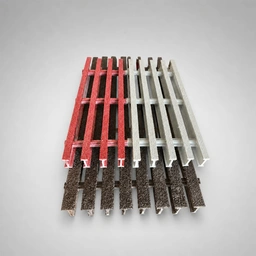
FRP Pultruded I-Type Grating
Long-span pultruded grating with I-shaped cross section
FRP pultruded grating with an I-shaped cross section —high strength-to-weight ratio for long unsupported spans, lighter panels and wide walkways.
View Details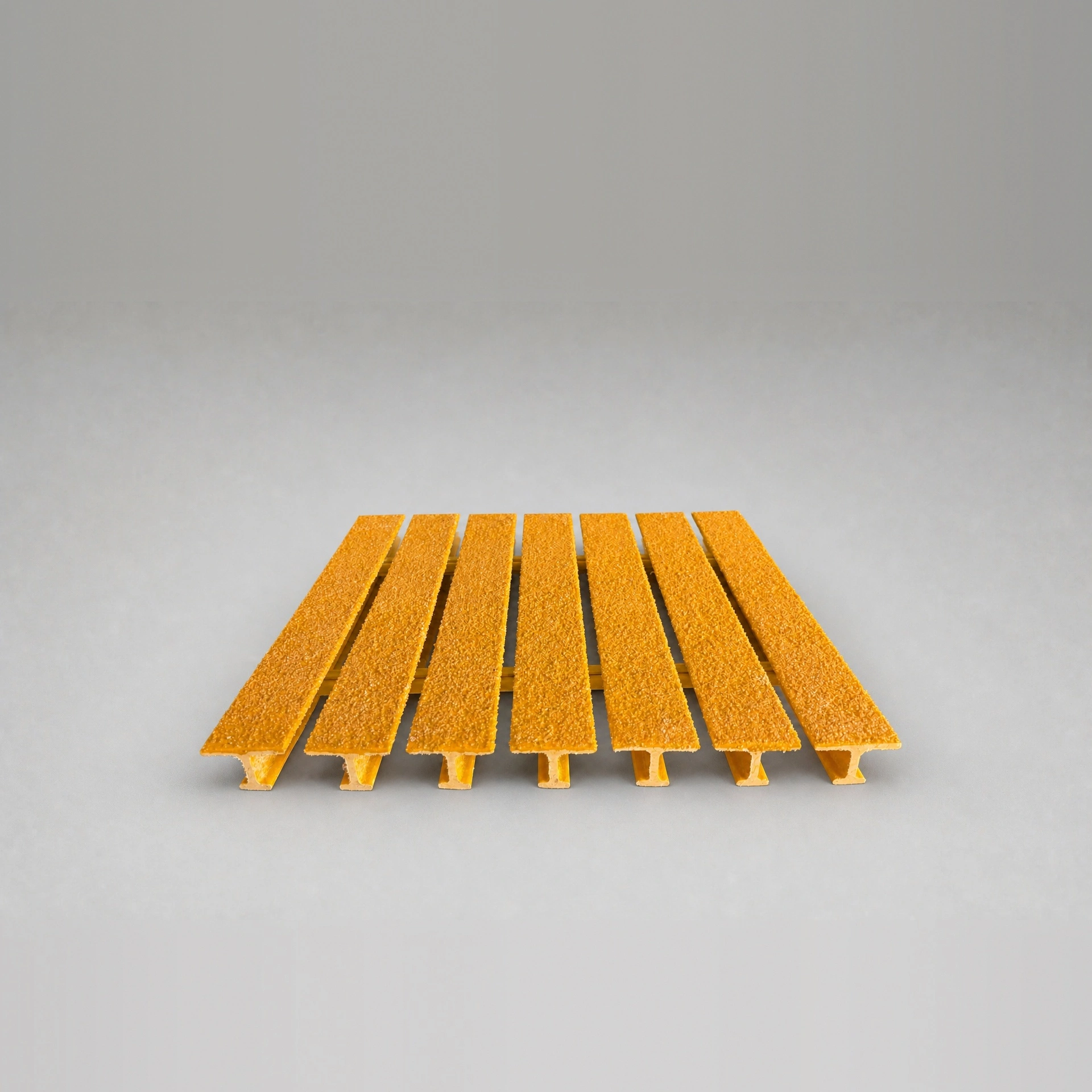
FRP Pultruded T-Type Grating
Heavy-duty pultruded grating with T-shaped cross section
FRP pultruded grating with a T-shaped cross section —engineered for heavy-duty industrial platforms, fork-truck alleyways and machinery-support decks.
View Details